Information about Tbilisi
History
The capital of Georgia, Tbilisi, is one of the oldest capitals in Europe. It was built in the 5th century, specifically in the 450s, by King Vakhtang Gorgasali.
The territory of Tbilisi was inhabited as early as the 4th millennium BC. In the historical district of the city – Abanotubani – remains of a settlement and a Roman-type bathhouse from the 1st – 3rd millennium BC have been discovered, which indicates a highly developed culture.
Located at the crossroads of Eastern Europe and Western Asia, Tbilisi has always been a home to people of different cultures and religions. It is a multi-ethnic and multi-religious city.
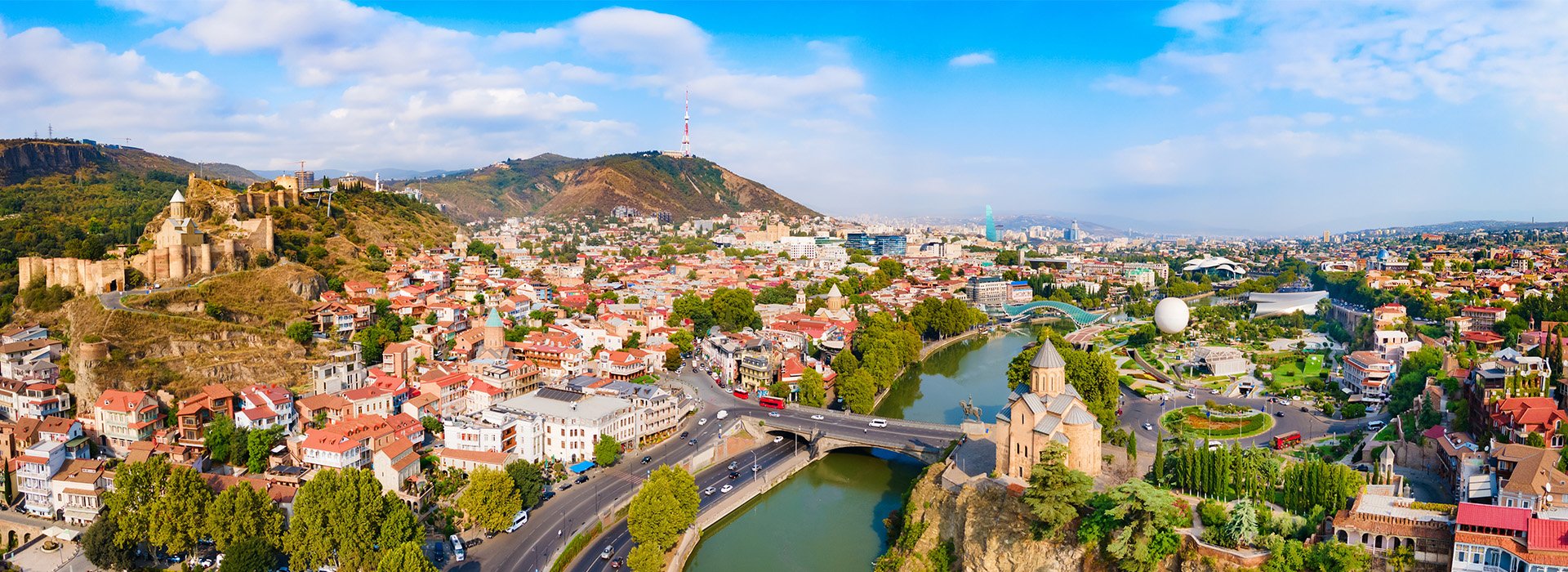
The city’s rich history is reflected in its architecture and cultural heritage – today’s Tbilisi is a blend of Georgian, Persian, Russian and European architectural styles, creating a unique urban landscape.
Geography
Tbilisi is located in eastern Georgia, on both banks of the Mtkvari River, at an altitude of 380–600 m above sea level. The highest point of Mtatsminda, the most famous mountain in the Tbilisi-surrounding mountains, is 719 m above sea level.
The highest among the residential areas is the so-called Nutsubidze Plateau – 700 m above sea level.
The city’s main water artery is the Mtkvari River, which crosses the city from northwest to southeast.
Climate
The average annual air temperature in Tbilisi is high and reaches 12.2 degrees Celsius. The coldest month is January – the average temperature is 0.9 degrees Celsius. The hottest month is July – with an average temperature of 24.4 degrees Celsius. Snow falls on an average of 15 days a year.
Tbilisi experiences little precipitation and the air is dry. The city is located at a low geographical latitude, which means that there is little cloud cover, and sunny days are abundant and long.
Strategic importance
Tbilisi is an important industrial, social and cultural center of the Caucasus region. The capital of Georgia is one of the most important transport hubs for global energy and trade projects (Baku-Tbilisi-Ceyhan oil pipeline and Baku-Tbilisi-Erzerum gas pipeline).
The city of Tbilisi is located on one of the routes of the historic Great Silk Road and occupies the position of an important trade and transit hub at the crossroads of Russia, the North Caucasus, Turkey, and the countries of the South Caucasus (Azerbaijan and Armenia).
Tbilisi landmarks
When you find yourself in this city with an ancient history, you can walk along the cobblestone streets of the old districts, where you will encounter cultural heritage monuments at every step; visit museums where Georgia’s rich past is exhibited; relax in modern parks and gardens, and taste Georgian wine and unique Georgian dishes in small, cozy cafes.
We recommend that you start your exploration of Tbilisi by visiting these attractions:
Narikala and Abanotubani: The oldest district of Tbilisi and its special exoticism – colorful, domed baths from the 18th century, where naturally warm, sulfurous water flows.
Holy Trinity Cathedral (Trinity): One of the largest Orthodox churches located on Elias Gora (Avlabari). The architect of the church is Archil Mindiashvili (1951-2020) – academician, Honored Architect of Georgia, graduate of the Faculty of Architecture of the Georgian Polytechnic Institute (1973).
Peace Bridge: A modern architectural masterpiece in the old quarter, over the Mtkvari River. This pedestrian bridge connects Erekle II Street (along with the adjacent embankment) and Rike.
Rustaveli Avenue – the unique building of the Opera and Ballet Theater, the Parliament, the National Gallery, the Rustaveli Theater, the Museum of Modern Art, the National Library and the Kashveti Church, shops, cafes, and green squares.
Metekhi Cathedral and the Monument to the Founder of Tbilisi, King Vakhtang Gorgasali: One of the most important and historical places in Tbilisi. From here, you can see Abanotubani in the palm of your hand.
Green spaces in Tbilisi
Tbilisi’s landscape is diverse, and the climate is moderately humid subtropical, which contributes to the presence of many green spaces in the city. Resting, walking, and exercising in the city’s parks is pleasant almost all year round.
Rike Park: A modern recreation area located in the city center, on the banks of the Mtkvari River. From here, you can take a cable car directly to Narikala Fortress.
Mtatsminda Park: The highest point of the city (719 m). From here you can see the entire city of Tbilisi.
Vake Park and Turtle Lake: A favorite route for students. From Vake Park, you can take a cable car or hike to Turtle Lake, which is a great place for swimming and sunbathing in the summer. If you continue on foot, you will come across the Ethnographic Museum, which is a miniature model of Georgia and reflects the diverse ethnoculture of the country.
Lisi Lake: Located in the higher part of the city, near the Nutsubidze Plateau (700 m above sea level), it is one of the most popular places in Tbilisi for cycling and spending time with friends.
Botanical Garden: Located at the foot of Narikala Fortress, this green oasis is best for those who love exotic flowers, tranquility, and watching waterfalls.
Tbilisi Sea and Dendrological Park: A reservoir located north of the city, where you can visit the yacht club or relax in a well-maintained park.

